
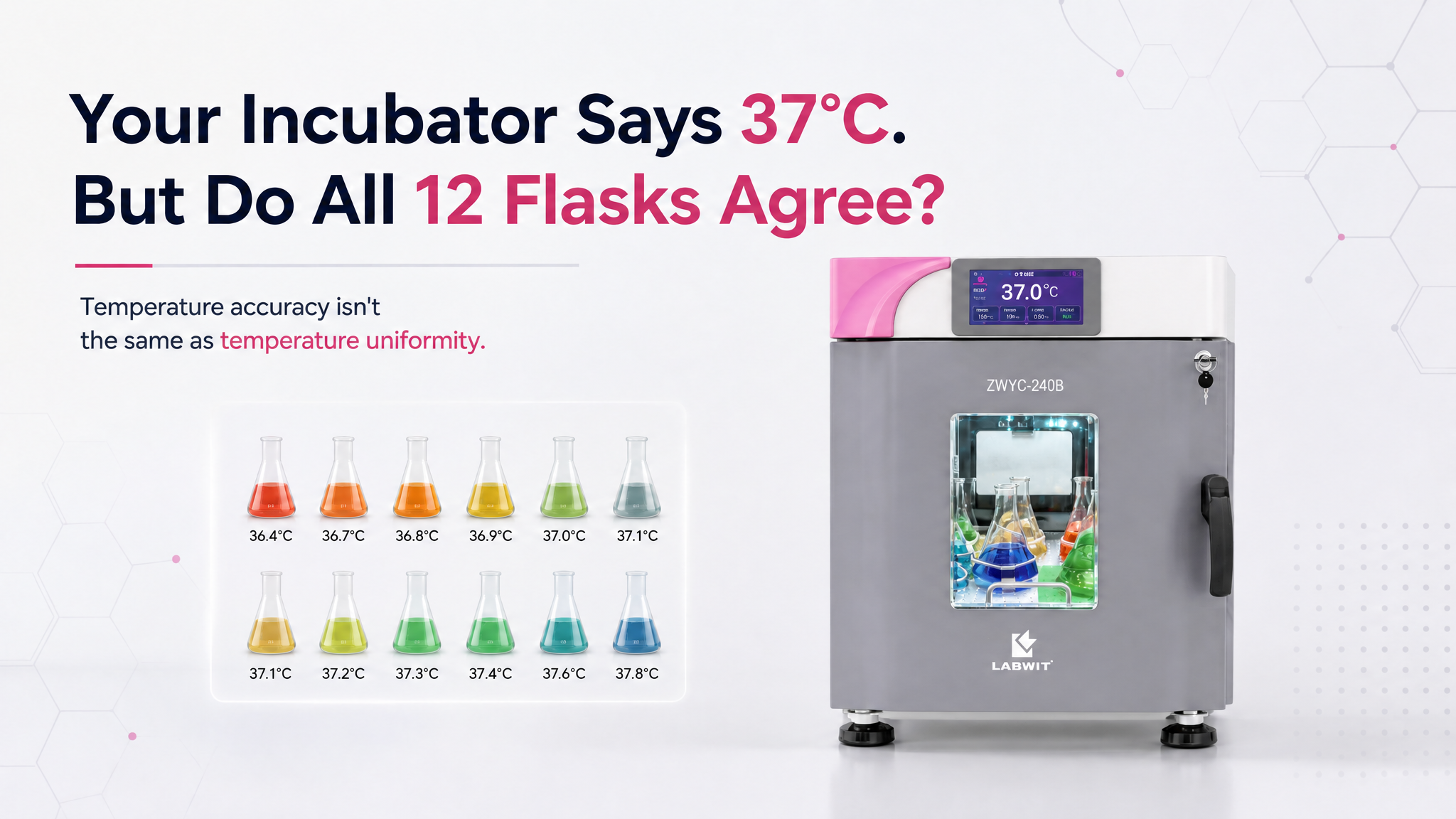
Imagine a routine Tuesday in upstream process development. You are screening 12 candidate clones, or optimising induction media for a high-value recombinant protein expression run using E. coli or mammalian suspension cells.
You prepare 12 identical Erlenmeyer flasks, inoculate each with a different candidate clone under comparable starting conditions, clamp them onto your shaking incubator tray, and set the controller to 37.0°C at 200 rpm. Over the next 48 to 72 hours, the digital display never wavers: a rock-solid 37.0°C.
Now imagine that, at harvest, Flask #4 delivers a 25% higher protein titer than Flask #11. Based on those results, you select Clone #4 for scale-up.
Here is the uncomfortable question: Did Clone #4 actually express better? Or was Flask #11 simply sitting in a thermal dead zone that was 0.8°C cooler or warmer than the center probe?
When you run 12 flasks side-by-side to identify your top performer, your screening efficiency depends on one fundamental assumption: that every flask on the tray is experiencing the exact same incubation environment. If the thermal conditions vary across the platform, you aren't screening biology anymore. You are measuring where the flask was clamped.
Same shaker model, same samples, both set to 37°C. The only difference is how evenly the chamber is heated.
A deviation of just ±1°C can change cell growth rates and expression levels
Different position, different result: flasks near the heater and by the door are no longer comparable
Even airflow and heating keep every flask position close to setpoint, so experiments repeat
The Spec Sheet Illusion: Temperature Accuracy vs. Temperature Uniformity
When comparing shaking incubators, it's easy to glance at a specification table, see ±0.2°C temperature accuracy, and assume temperature control has been addressed. But a precise reading at one point doesn't necessarily mean the entire chamber is experiencing the same conditions.
Three specifications are worth distinguishing:
How closely the measured temperature at a specified location matches the target or reference temperature.
How much the temperature at a particular measurement point changes over time.
How consistently temperature is maintained across different locations within the chamber.
A shaking incubator can demonstrate excellent temperature accuracy and stability at its control point while still experiencing temperature differences across the tray. For researchers comparing multiple cultures, it's this spatial variation that deserves closer attention.
Why Chamber Physics Fights You as You Scale
Why does maintaining consistent temperature become more challenging as the incubation chamber gets larger?
In practice, the larger the chamber volume, the harder it is to maintain spatial homogeneity. Air is a relatively poor conductor of heat. Moving air evenly across a 190L to 580L chamber filled with shaking glass flasks creates complex turbulence, boundary layers, and corner eddies. Some high-capacity shaking incubators are specified at ±1.0°C uniformity at 37°C, illustrating the challenges of maintaining consistent temperatures across larger chambers.
Culturing suspension cells or high-density E. coli requires continuous orbital agitation (often 200–300 rpm) to drive oxygen transfer. In traditional shakers, heavy AC motors and belt-driven mechanisms generate internal friction and radiant heat right beneath the shaking tray. The incubator's cooling compressor then has to fight that localised heat plume, creating warm spots near the drive and cold spots near the evaporator coils.
Viewing windows and door seals are the weakest thermal links in any incubator. Without multi-layer insulation and precision door geometry, ambient room fluctuations bleed through the front glass, cooling the front row of flasks while the back row runs warm.
Thermal Homogeneity as “Productivity Insurance” in Protein Expression
In microbial cultivation and mammalian suspension culture, temperature is the master regulator of cellular metabolism:
Temperature influences microbial growth, protein expression rates, and folding efficiency. Depending on the recombinant protein and induction conditions, elevated temperatures can increase the risk of misfolding and formation of insoluble inclusion bodies. Maintaining consistent temperatures across culture flasks helps reduce an environmental variable that could otherwise complicate comparisons between experimental conditions.
Mammalian cell cultures are sensitive to their incubation environment. Temperature variations can influence cellular metabolism, viability, productivity, and potentially product quality attributes. The extent of these effects depends on the cell line, culture conditions, and duration of exposure. Consistent temperature control helps researchers interpret differences between cultures with greater confidence.
When your incubator delivers a truly homogenised thermal environment, you reduce temperature-related positional variation. Tight uniformity acts as thermal insurance for your workflow:
1. True Screening Efficiency: When you compare 12 flasks side-by-side, you can better distinguish biological differences from temperature-related variation, not tray position.
2. Batch-to-Batch Reproducibility: Consistent environmental conditions help improve reproducibility across subsequent runs when replicated across the entire platform next week.
3. Reliable Scale-Up Baselines: Downstream bioprocess engineers get more consistent kinetic data before committing expensive media to larger vessels.

Illustration of temperature uniformity in a chamber
What to Look for When Comparing Temperature Uniformity
Not every laboratory workflow requires the same level of temperature uniformity. For general microbial cultivation, chamber capacity and flask throughput may be the priorities. For sensitive cell culture and clone screening, tighter temperature uniformity may become more important.
Labwit's shaking incubator range illustrates these differences. High-capacity models such as the ZWYR-D2403 offer ±0.5°C uniformity at 37°C, while the compact ZWYC-293G and ZWYC-240B achieve ±0.3°C and the larger ZWYC-290A achieves ±0.2°C.
The goal isn't necessarily to choose the tightest specification available. It's to understand how temperature variation could affect the reliability of your experimental results.
The Dual Benchmarks of Thermal Control: ZWYC-290A and ZWYC-240B

For research teams running high-stakes cell culture, clone screening, and synthetic biology where thermal variance simply isn't an option, Labwit offers two benchmark models engineered for absolute thermal homogeneity.
Leading the category with the tightest uniformity is the high-capacity ZWYC-290A Ultimate-Cell Stackable Incubator, achieving ±0.2°C temperature uniformity at 37°C—among the tightest in its class. Serving as the benchtop benchmark is the ZWYC-240B Ultra Elite, which delivers an exceptional ±0.3°C temperature uniformity at 37°C.
How do these chambers keep their corners within fractions of a degree of the center probe? Achieving this level of temperature uniformity requires more than a precise temperature sensor. It depends on how heat is generated, distributed, and controlled throughout the incubation chamber.
The ZWYC-290A utilises an advanced optimised air circulation system combined with a solid polyurethane casing to optimize insulation and distribute air evenly across its 257L chamber. Meanwhile, the ZWYC-240B combines a solid-state Peltier heating and cooling system, a low-heat FOC magnetic direct drive, and an insulated chamber with forced-air circulation. These design features work together to support consistent temperature conditions across the shaking platforms.
Is Temperature Uniformity Affecting Your Experimental Results?
When comparing protein expression yields or cell culture performance, temperature uniformity is an important variable that can be easy to overlook. Understanding how your shaking incubator maintains temperature across the chamber can help you make more informed decisions about experimental reproducibility.
For researchers interested in the engineering behind tighter temperature control, explore the updated Labwit specifications:
Frequently Asked Questions
What is the difference between temperature accuracy and temperature uniformity in a shaking incubator?
Temperature accuracy measures how closely a measured temperature matches the target or reference temperature at a specified location. Temperature uniformity measures how much temperatures differ across locations within the incubator chamber. Temperature fluctuation is a separate measurement describing changes over time at a particular location.
Why does temperature uniformity matter for protein expression and cell culture?
Temperature differences between culture flasks can introduce an additional variable into protein expression and cell culture experiments. Depending on the organism, cell line, and experimental conditions, these differences may influence growth, protein expression, or cell productivity, making it harder to distinguish biological performance from environmental variation.
How do the Labwit ZWYC-290A and ZWYC-240B achieve such tight temperature uniformity?
Achieving tight uniformity requires advanced thermal engineering. The 257L ZWYC-290A (achieving ±0.2°C at 37°C) relies on an optimised air circulation system and solid polyurethane casing for optimized insulation. The ZWYC-240B (achieving ±0.3°C at 37°C) combines a solid-state Peltier heating and cooling core (eliminating compressor vibration and reducing localised hot spots), a low-heat FOC magnetic direct drive mechanism, and precision double-layer glass insulation with forced-air circulation to minimise spatial temperature differences across its 120L chamber.
Does the ZWYC-240B support compliance requirements like GMP and 21 CFR Part 11?
Models like the ZWYC-240B include features that can support data integrity and traceability in regulated laboratory environments, including time-stamped audit trails, three levels of user access management, and read-only USB data export. However, compliance with GMP or 21 CFR Part 11 depends on the laboratory's overall systems, validation, procedures, and applicable regulatory requirements.