
Why standard shakers don't last in a CO2 incubator
A conventional benchtop shaker keeps its controller and electronics inside the machine body. That works on an open bench. Inside a CO2 incubator, three things work against it:
-
Heat and humidity. Sustained 37°C and near-saturated humidity is the opposite of what circuit boards are designed for.
-
CO2 and moisture. CO2 dissolves in condensation to form a weak acid. Over time, moisture and acidic vapour work their way into housings and attack the components inside.
-
Belts and wear. Belt-driven mechanisms wear, and worn belts shed fine particles. That's an unwelcome contaminant source in a culture environment.
The result is a shaker that fails early, or a lab that decides it can't shake and incubate at the same time.
The usual workaround, and its cost
The standard answer is a dedicated CO2 shaking incubator. They're excellent, but they mean a new capital purchase and a new footprint. With tighter budgets and crowded labs, that's a hard sell when a perfectly good CO2 incubator is already sitting on the bench.
A different approach: the shaker designed for the environment
The ZWY-304C is built around the incubator's conditions rather than despite them.
-
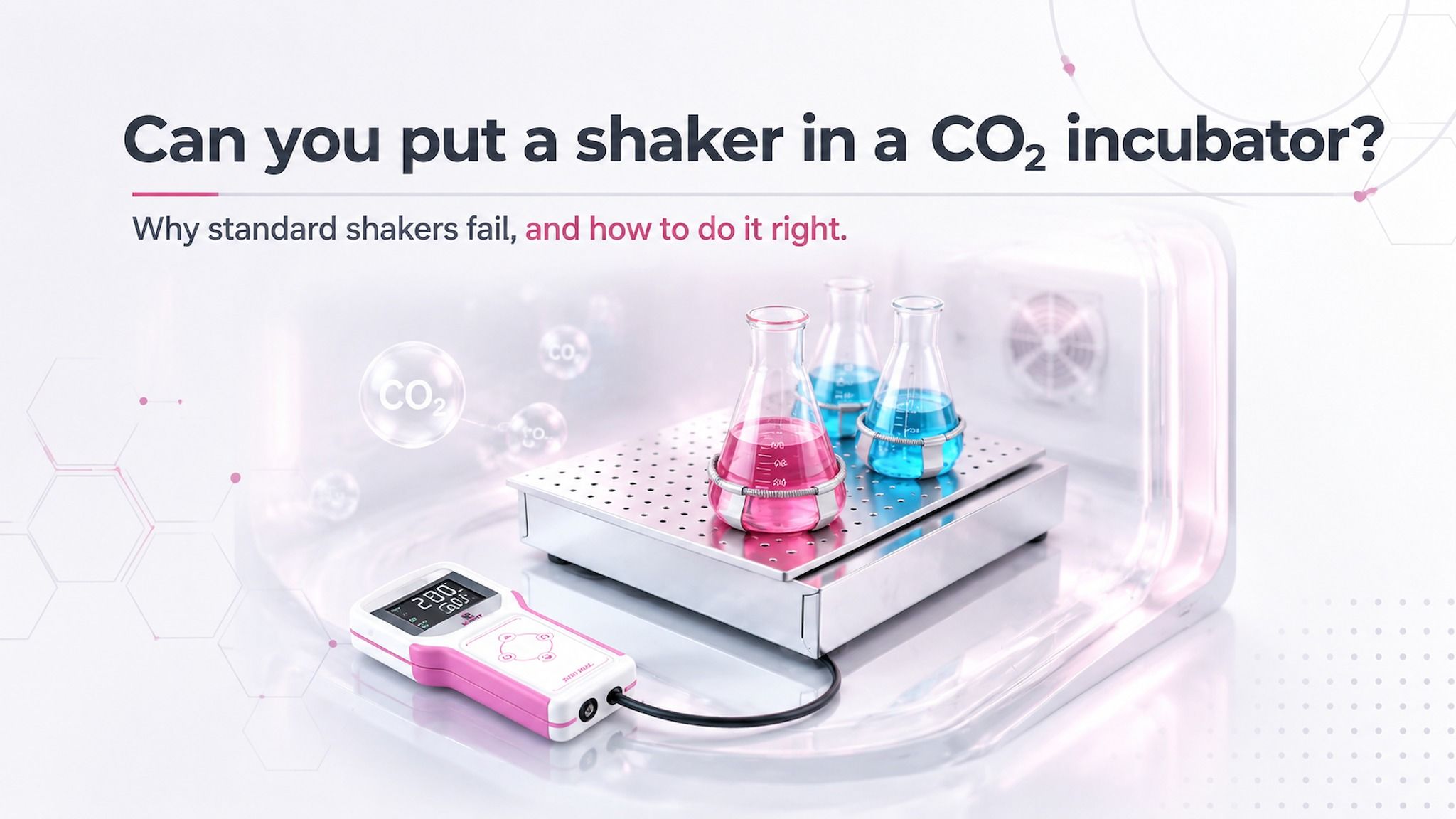
Remote handheld controller. The controller sits outside, connected by a detachable cable that passes through the incubator's access port. You adjust speed and time without opening the door, so CO2, temperature and humidity stay stable.
-
Magnetic direct drive, no belts. No belt wear, no particulate from worn belts, and a maintenance-free drive.
-
18W low-power motor. Less power means less heat released into your 37°C environment.
-
Rated for the conditions. Designed for long-term operation at 37°C, 20% CO2 and up to 95% RH, with a stainless steel shaker body.
-
10-level orbit adjustment, 3-50 mm. Gentle mixing through to vigorous shaking on one platform, with a 25 mm default.
-
Speed 20-350 rpm, ±1 rpm accuracy. Fixed-value mode, or a 9-segment program mode for multi-step workflows.
-
Built-in protection. Stall and overspeed alarms with active braking, automatic resume after power failure, and password-protected parameters for shared labs.
-
Clockwise or counter-clockwise rotation.
What this means in practice
Put the 304C inside your CO2 incubator and it becomes a CO2 shaking incubator. Need static culture? Lift the shaker out. Need shaking again? Put it back. The same incubator covers both jobs, which saves you from buying a second system and finding space for it.
Who it suits
-
Research labs growing suspension cells (CHO, HEK293 and similar) in flasks.
-
Biotech and biopharma R&D teams running small-scale process development.
-
Teaching and shared labs that need flexible, protected settings.
-
Any lab that already owns a CO2 incubator and wants shaking without a new system.
When a full CO2 shaking incubator is the better choice
If you need integrated CO2 control, temperature control built into one system, or audit trails and electronic records for regulated work, look at a purpose-built system such as the ZWYC-240B. The 304C is the flexible, budget-conscious option for labs that already have the incubator.
Frequently Asked Questions
Q: Can I put a normal orbital shaker in a CO2 incubator?
A: Generally not. Heat, humidity and CO2 can damage the internal electronics of standard shakers, which is why a CO2 resistant design is recommended.
Q: What makes the ZWY-304C CO2 resistant?
A: Its controller is a separate handheld unit that stays outside the incubator, and it uses a belt-free magnetic drive. It's designed for 37°C, 20% CO2 and up to 95% RH.
Q: Does a shaker in the incubator change the temperature?
A: It adds some heat, as any motor does, but the 304C runs at a maximum of 18W, so heat output is kept low.
Q: Can I change the settings without opening the door?
A: Yes. The handheld controller connects by cable through the incubator access port.
Q: How much can it hold?
A: Maximum load is 7.5 kg on a 365 × 350 mm tray. As examples, 250 ml × 16, 500 ml × 9, 1000 ml × 6, or 1 × 5000 ml flask.
Q: Will it fit my incubator?
A: It measures 365 × 355 × 93 mm with the platform. Check your chamber's internal dimensions and shelf load rating (the shaker weighs 15 kg net).
Talk to Labwit Scientific about adding shaking to your CO2 incubator.