
In the competitive landscape of biopharmaceutical manufacturing, the timeline from initial microbial screening to commercial-scale mammalian protein expression is critical. Every operational delay, redundant equipment purchase, and compromised batch directly translates to lost revenue and wasted capital investment. For modern biopharma facilities, scaling new products to market requires infrastructure that adapts to the science, rather than forcing the science to adapt to the infrastructure.
The industry is currently facing a significant throughput dilemma. Facilities are increasingly constrained by legacy equipment, specifically, traditional shaking incubators restricted to rigid, fixed-orbit dimensions. While a fixed 25mm system may suffice as a baseline for standard bacterial expression, the reality of commercial scale-up demands seamless transitions between highly diverse research phases. Overcoming this requires a fundamental shift in how we view foundational lab equipment: moving away from single-purpose hardware and embracing adaptive, multi-variable platforms like the Labwit ZWYC-290A Ultimate-Cell Stackable Shaking Incubator.
The Biology of Agitation: Why Fixed Orbits Fail At Some Real World Scenarios
The transition from R&D to commercialisation is rarely linear. A laboratory may spend weeks engaged in high-throughput microbial screening in 96-well plates, only to pivot immediately towards mammalian cell line expansion for recombinant protein expression.
Historically, this pivot required physically transferring operations between completely different machines. The physical mechanics of gas-liquid mass transfer, specifically the Oxygen Transfer Rate (OTR), change drastically depending on the vessel size, the biological makeup of the cells, and the orbital diameter of the shaker.
Forcing a single fixed-orbit machine to handle this entire spectrum inherently compromises both cellular viability and volumetric yield. Facilities are forced to purchase redundant fleets of equipment to accommodate different biological requirements, which consumes highly valuable floor space and complicates validation protocols.
Mammalian Scale-Up (CHO & HEK293): Fragility Meets Demand
To achieve high-yield protein expression, laboratories rely heavily on mammalian cell lines such as CHO (Chinese Hamster Ovary) and HEK293. However, culturing these cells presents a unique physical challenge: mammalian cells lack a rigid cell wall.
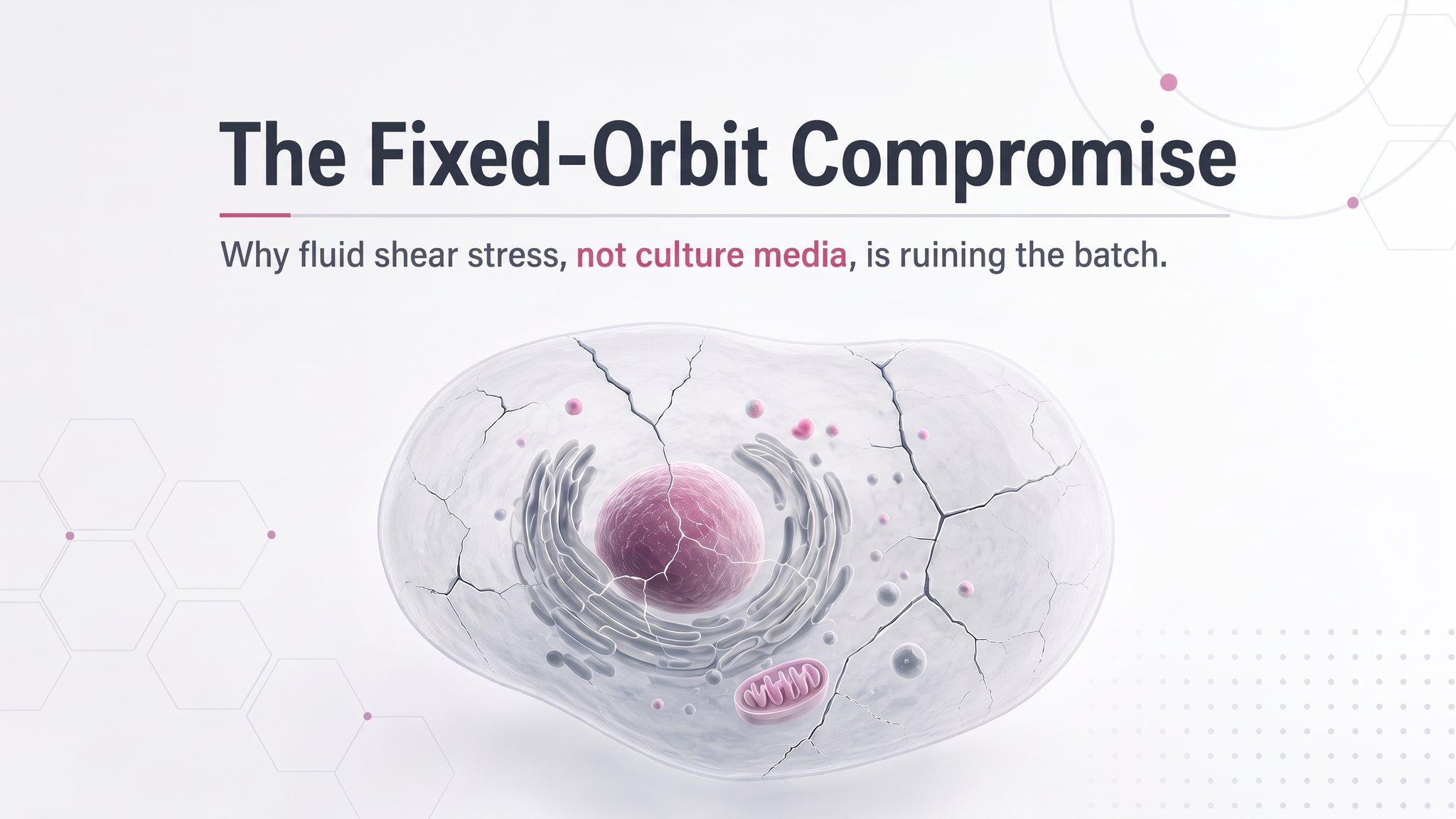
Protected only by a fragile plasma membrane, these cells are extremely susceptible to mechanical shear stress. Attempting to increase the oxygen transfer rate by simply ramping up the RPM on a standard, tightly orbited shaker creates fluid shear that outpaces the oxygen transfer gains, putting membrane integrity at risk for cells with no protective wall. The biological solution requires a wider throw. Utilising an innovated multi-balanced driving system, modern platforms allow the shaking diameter to be step-lessly adjusted from Ø1-50mm. By expanding the orbit to 50mm, researchers can utilise a gentle, sweeping agitation. This wide orbit maximises the surface area of the media exposed to the atmosphere, achieving the high OTR required for dense protein expression while maintaining a low-shear environment.

Furthermore, true mammalian consolidation requires flawless atmospheric integration. Because these cultures incubate in vented flasks for extended periods, they are highly prone to evaporation and pH shifts. Advanced systems solve this by pairing step-less orbital shaking with robust environmental controls. An advanced single beam, dual wavelength infrared (IR) sensor guarantees superior accuracy for CO2 concentrations ranging from 0-20%. Simultaneously, a 140°C steam direct injection humidification system actively maintains humidity levels up to 40–85% RH depending on configuration to effectively prevent samples from drying out during long-term cultivation. This is all stabilised by a solid polyurethane casing and PID controller that ensures an exceptional temperature uniformity of ±0.15°C at 37°C.
The Microplate Bottleneck: Microbial High-Throughput Screening
While mammalian scale-up requires finesse, the early stages of biopharma development, specifically high-throughput microbial screening, demand sheer volume and aggressive aeration. The industry standard relies heavily on 96-well deep-well plates, which introduces a notorious operational bottleneck.
In a standard fixed-orbit shaker, the fluid motion inside a highly constrained 96-well plate is severely restricted by capillary action and surface tension. To overcome this without needing a dedicated microplate shaker, researchers can dial down the step-less adjustment to a tight 1mm to 3mm orbit while simultaneously pushing the maintenance-free brushless motor towards its maximum speed of 300rpm. This smooth, vibration-free movement creates a vigorous vortex within every single well, eliminating oxygen starvation so researchers can reliably screen hundreds of variants simultaneously.
The Ultimate ROI: Footprint Optimisation and Maximum Capacity
Future-proofing a biopharma laboratory is not just about biological adaptability; it is a calculated optimisation of physical real estate. Lab spaces are spacious and expensive, making the maximisation of square footage a top financial priority.
The financial return on investment (ROI) of an adaptive platform is realised through extreme vertical scalability. Units like the ZWYC-290A can be stacked up to 2-3 units high, offering multiplied incubation capacity on a single unit footprint. Each individual 257L chamber boasts an extended effective inner height of 425mm, making it fully compatible with massive 5000ml flasks.

When assessing throughput, the raw capacity metrics are staggering. Driven by a system capable of handling a maximum load of 25 kg, a single P6023 plain shaking tray equipped with sticky mats can simultaneously agitate up to thirty-two 500ml flasks, eighteen 1000ml flasks, six 5000ml flasks, or twenty-four 96-well plates. By retiring heavy, restrictive metal clamps in favour of sticky mats, technicians can fully utilise the platform's real estate and instantly swap vessel sizes without downtime.
Securing the Process and Data Integrity
All of this operational capacity is meaningless if the biological data is vulnerable. Modern commercial scale-up requires integrated security and automation. A microprocessor controller allows users to create personalised programmes with up to 10 segments to automate parameter changes.
To protect the batch, a Password Door Lock System prevents unauthorised changes to operational parameters during long-term cultivation. Furthermore, non-volatile memory guarantees data integrity in the event of a power interruption. All units are equipped with a standard USB port, allowing the controller to save thousands of records of operation data internally, ensuring the physical and digital safety of the batch is completely assured.
In an industry where speed to market defines success, operational rigidity is a serious liability. Consolidating high-throughput screening and delicate mammalian protein expression into a single, stackable, precision-engineered environment empowers biopharma companies to push the boundaries of their research, scale with absolute confidence, and reduce wasted capital investment. This is a complete workflow transformation you can review further by checking out the ZWYC-290A Technical Whitepaper. Ready to see the ZWYC-290A in your own workflow? See full specification here or contact us to discuss configuration for your facility.
Frequently Asked Questions: Optimising Biopharma Incubation
Q: What is the optimal shaking diameter for CHO and HEK293 cell culture?
A: The optimal shaking diameter for mammalian cell lines like CHO and HEK293 is a wider 50mm orbit at moderate speeds. Because these cells lack a rigid cell wall, a narrow orbit forces higher RPM to reach adequate oxygen transfer, and shear stress rises faster than OTR does at that RPM, putting cell viability at risk. A wider throw achieves the same oxygen transfer at gentler agitation.
Q: What is the maximum flask capacity of the ZWYC-290A shaking incubator?
A: Using a P6023 plain shaking tray equipped with sticky mats, a single ZWYC-290A chamber can hold up to thirty-two 500ml flasks, eighteen 1000ml flasks, or six 5000ml flasks, matching the same configuration used for mammalian expansion and microbial screening runs.
Q: How does the ZWYC-290A protect biological data integrity during long-term cultivation?
A: Non-volatile memory protects cycle settings during power interruptions, while the internal controller automatically logs over thousands of records of operational data for compliance auditing.
Q: Why is direct steam humidification necessary for mammalian cell scale-up?
A: Direct steam injection (operating at 140°C) provides sterile, active humidity control (40–80% RH). This prevents critical culture media from evaporating out of vented flasks during multi-week batch runs, maintaining precise pH and osmolarity without introducing waterborne contaminants into the chamber. Compared to classic passive humidity monitoring, active humidity control provides fast recovery after door opening and stable control over the extensive period of incubation.